At Sicché we are all qualitative researchers and, as such, we know well that the fascinating (and, honestly, somewhat demanding) part of our work isn't collecting data, but understanding and interpreting it.
When a community closes, when the last diary is filled in, when the pre-tasks are all there waiting for us... that's when the real work begins: reading hundreds of open-ended responses, reconstructing the threads, coding, isolating verbatims…
Lovely work, nonetheless, but it requires time, clarity and great patience.
This is where a reflection began, developed in parallel with the creation of Pino, our AI co-moderator: what if AI could give us a hand in the analysis phase too? What if it could shorten the distance between participants' responses and the first, real insights?
Before getting into specifics, there's a premise that matters a great deal to us: Sicché's AI was conceived and designed by qualitative researchers, not by people selling AI-based tools. A small but substantial difference, because it means the priority has always been data quality, not speed or the "wow" effect.
Let's be honest: we've seen plenty of examples of AI inside research tools that return results that are fast, polished and… completely wrong. Hallucinations, misattributions, misleading associations, contradictory summaries. All very impressive, but wrong 😅.
That's why our AI works with what we like to call an "active brake": it's not a total delegation to artificial intelligence, but an accompanied AI, kept within precise boundaries it cannot cross, precisely to minimise the risk of errors and maintain strong oversight of the content.
It's the human-in-the-loop principle: the researcher always stays at the centre, the AI is a support tool.
Sicché's AI comes into play at the two most demanding moments of a researcher's work: moderation and analysis.
In moderation, there's Frank, whom we've already discussed in this dedicated article. He handles the simpler follow-up probes, the ones triggered when a response is vague, incomplete or off-topic, and will soon be enhanced with a new type of question format, the conversational chat (which we'll tell you about in due course…).
In analysis, the focus of this article, the AI works alongside the researcher on what is probably the most time-consuming task in the entire research process: making sense of the content collected.
Analyses can be launched for a single question or an entire activity and, once completed, they are saved. They can be reviewed at any time from the Analysis & Export section, filtered by room, section, day, or specific activity.

What are the questions we ask ourselves most often as researchers when faced with a large volume of open-ended responses?
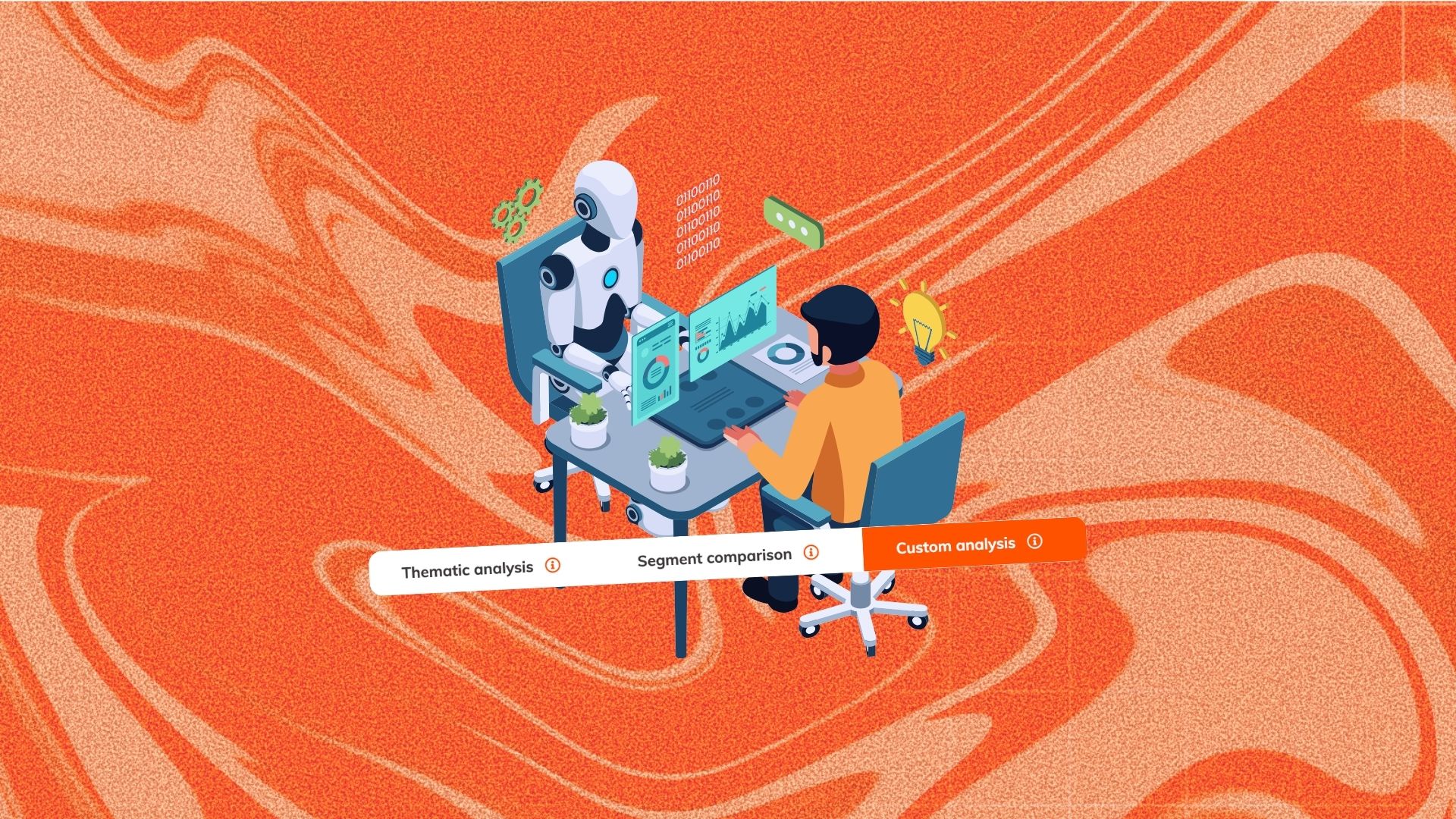
Three emerged, and each one corresponds to a type of analysis.

This is almost always the first question we ask. Thematic analysis reads all the collected responses and returns a reasoned summary of recurring themes, accompanied by the most significant verbatims supporting each theme.
When to use it? Practically always: at the start of analysis, after a particularly rich open-ended question or an activity that generated a lot of material.
It's like having an assistant who has already read everything and tells you: here are the five threads to pull on first.
Segment comparison is a cross-analysis that draws on the sample variables you set up during project configuration: age, gender, consumption cluster, custom segments… whatever makes sense for your project, and systematically analyses whether and how these variables correlate with particular responses, attitudes or tendencies.
Heavy vs. light users. New customers vs. long-standing ones. City dwellers vs. small-town residents. Can you imagine how long it normally takes to tease out these differences manually? And how often, pressed for time, you end up taking a rough "gut feel" glance and nothing more?
Differences between segments are often where the most valuable insight hides, and finding them by hand takes hours; with AI, minutes.
Custom analysis is a chat with your research results: you formulate your question in natural language, exactly as you would put it to a colleague. The response takes into account all the questions (and users' corresponding answers) from the activity, with the option to apply filters on sample variables to narrow the focus on a specific sub-group.
It's the most open-ended mode, and the one that proves most useful in two particular moments: when a hypothesis arises mid-project that you want to verify on the fly, and when you're preparing a specific chapter of the report and need a targeted perspective.
"What if I wanted an AI analysis of the entire research project, all activities together?"
Honest answer: not within the platform, and it's a deliberate choice. We chose to limit AI analyses to well-defined research units (a single question or activity) because these are contexts where a topic is opened, explored and closed, where the risk of hallucinations and misinterpretations can be kept under control.
That said, if there's a need to analyse the entire dataset, we have two alternatives.
From the Analysis & Export section, in addition to the classic XLS and PDF formats, you can download the entire research content in an AI-friendly format: a lightweight file, optimised to be loaded directly into an external LLM and used as the basis for custom analyses.
The important detail is that each response always carries with it the sample variables of the person who gave it: "Who said what" is embedded in the file, row by row, so that the external LLM can be queried not only on content but also on differences between sub-targets and clusters, exactly as with the segment comparison within the platform.
For those with even more structured needs, we have formed a partnership with a platform specialised in qualitative data analysis via AI.
We won't go into detail here, because every project has different requirements and we prefer to build a tailored solution: get in touch and we'll explain how it works 😀
Sicché's AI, with Pino in moderation and AI analyses and AI-friendly export in the analysis phase, doesn't aim to replace the researcher, but rather to give back the hours they would spend reading line by line, so those hours can be invested in interpretation, in building the narrative, or in conversations with the client.
The quality of research isn't measured by how many responses you've read, but by how well you've understood them.
Try them out on your next project, and if you'd like, we're happy to walk you through a dedicated demo. You know where to find us 😉