If you work in qualitative market research, you've definitely heard about discussion guides. But what exactly are they?
A discussion guide is much more than a simple list of questions: it's the strategic flow of conversation you'll have with your respondents. Its goal? To fully address research objectives and meet client requirements.
The beauty of a good guide lies in its flexibility. It's designed to be followed, but also to be adapted in real-time. During an interview, you can follow the natural flow of the respondent, as long as you cover all key topics. Between sessions, you can modify it by adding new questions based on emerging insights.
Creating an effective discussion framework requires several skills that develop with experience:
Strategic synthesis ability: Knowing how to transform client requests into key guide areas, then into precise and unbiased questions
Target empathy: Putting yourself in the consumer's shoes (are questions in the right order? Are they understandable?)
Complete vision: Including all possible motivations respondents might reference, while remaining neutral without going off-topic
Field experience: Having handled similar topics in the past
Time management: Accurately estimating time needed for each section (every guide always includes a detailed timeline)
Every discussion guide consists of modular thematic blocks. Each block always contains three fundamental elements:
Examples of blocks you might find:
Opening block: "Introduction and ice-breaking" - questions for introductions and atmosphere creation (5-10 minutes)
Framing block: "General sector perceptions" - broad questions to introduce the topic (10-15 minutes)
Deep-dive blocks: "Product X usage experience" - specific questions on key themes (15-25 minutes each)
Testing blocks: "Concept A vs Concept B evaluation" - presentation and analysis of materials with rotations (20-30 minutes)
The beauty of modular structure? Each block can be adapted, reordered, or replaced based on specific research objectives, while always maintaining clear temporal and thematic logic.
In online research like communities, digital diaries, or pre-tasks, guides are organized into activities.
An activity is simply a section of the discussion guide: a specific topic containing one or more related questions. Each activity has:
A well-structured guide for asynchronous qualitative research features clear question division into time-organized activities, without overloading participants.
Here's a crucial aspect often overlooked: every section of the discussion guide becomes a chapter in the final report.
The discussion framework flow is almost always identical to the final presentation flow, whether it's reports, presentations, or video reports. This correspondence isn't accidental: it reflects how we researchers think and analyze topics, one section at a time.
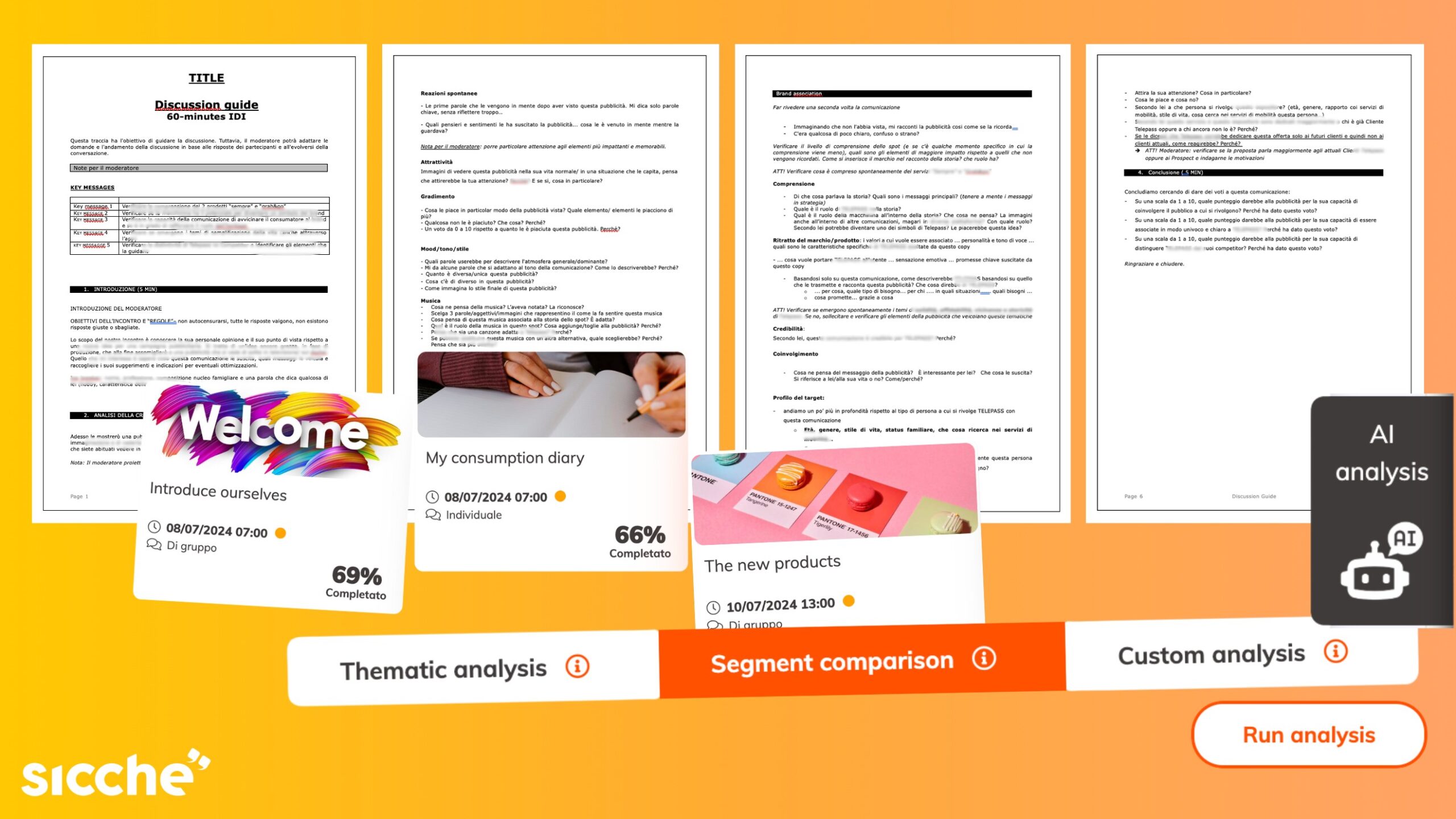
Starting from this structural logic, we developed Sicché's AI to follow exactly the researcher's mental flow: by question or by activity.
You can deep-dive into any key question (open, with sub-questions, video, or voice) to get specific insights.
Analyze an entire theme through all related questions, even with dozens of questions or hundreds of participants.
1. Thematic Analysis: Smart summaries using our specialized prompts
2. Segment Comparison: The system identifies correlations between sample variables (differences by gender, age, behaviors, etc.)
3. Interactive Chat: You can "discuss with results," interrogating participant data on specific themes
Our approach is based on a fundamental principle: AI should enhance the researcher, not replace them.
Unlike other platforms that offer generic AI for data analysis, our artificial intelligence:
While other platforms offer you generic text analysis tools, we've built an AI that speaks your professional language and follows your established methodology.
The best AI for qualitative market research is one that helps you understand, establish relationships, and answer specific questions following YOUR work methodology.
We started with a simple question: how do researchers think and organize their work? The answer was obvious: through discussion guides, section by section, question by question.
Our AI doesn't force you to adapt to new workflows or learn different logics from those you've been using for years. Instead, it amplifies and speeds up the analysis process you already know perfectly.
A well-structured discussion guide is the foundation of every successful qualitative research project. With Sicché's AI, that structure also becomes the key to faster, deeper, and more controlled analysis. Unlike other platforms, you won't have to revolutionize your way of working: our AI adapts to your methodology, not the other way around.