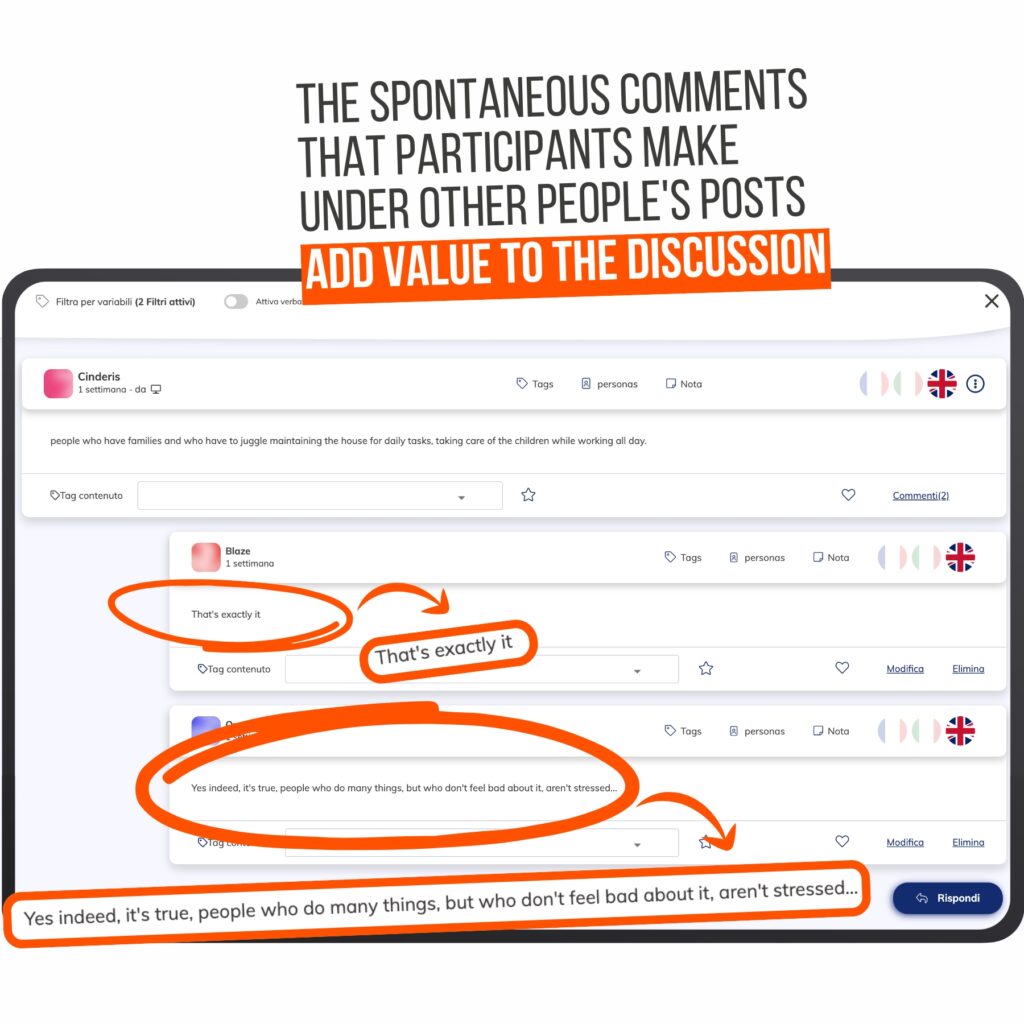
One of the things most frequently pointed out to us by those using Sicché for the first time is the high number of spontaneous comments that emerge within asynchronous group discussions.
When participants can read others' responses, their curiosity and desire to engage naturally increase. Some leave a comment to add a perspective, some give a like to signal agreement, others open a new thread to dig deeper.
These spontaneous contributions enrich the conversation and generate denser, more authentic insights, especially on topics that touch on relevant personal or social themes. It's an added value that's often missing in platforms that limit interaction or postpone it until the end of the activity.
Be careful, though. This type of comment is generally rare, because it's an extra effort required of the participant, who must take initiative, read some of others' responses, and share their thoughts on those as well. Therefore, some "helpers" are needed, namely...
The secret lies in the platform's design itself, conceived since 2020 to stimulate natural and continuous participation.
With Sicché, the researcher can choose for each activity whether to set it up as individual (1:1 dialogue with the moderator) or as a group (where everyone reads and comments on others' responses).
But here's the real difference:
In Sicché, each participant can read others' responses immediately after answering each question, not just at the end of the entire activity.
This small detail makes a big difference. After answering, the participant is still "mentally engaged" with the topic and, upon reading others' opinions, feels more motivated to interact, compare views, and comment.
In competing platforms—such as Recollective—participants can only see others' responses at the end of the entire activity 😲. At that point, however, the initial interest and curiosity have often already faded, drastically reducing the likelihood of obtaining spontaneous interactions and therefore valuable insights.
All of this stems from a simple but not obvious principle: at Sicché, we put the user experience at the center. From the beginning, we've developed the platform with an obsession for UX and UI, trying to put ourselves in the participant's shoes, not just the researcher's.
We always ask ourselves:
This is why Sicché is today one of the platforms with the richest variety of question formats available and, above all, one of the most interactive. Because qualitative research, to be truly such, must foster sharing, comparison, and authentic dialogue among people.