In uploading discussion guides to Sicché for online forums and being qualitative researchers, we have often come across some recurring errors that can compromise the quality and effectiveness of research. We have thus collected our observations, with the aim of offering suggestions to optimize the guides and improve the discussion experience, avoiding as much as possible issues that can compromise the quality of the results obtained!
One of the most frequent mistakes is to treat different methodologies as if they were interchangeable. For example, we frequently see reusing without adjustment a guide designed for focus groups in an online forum. But changing only the time distribution of different questions is not enough and risks compromising the effectiveness of the results.
In fact, it is crucial to take into account the type of methodology. In particular, with regard to online communities, special attention should be paid to:
Another recurring mistake is to propose redundant or overly similar questions to seek confirmation. But the result is often counterproductive. In fact, for respondents, this is an approach that in the long run
Therefore, we recommend…
An effective discussion guide must be tailored to its target audience and the specific research context.
In fact, not adapting the language or tone of voice of questions to the target audience can generate misunderstandings or poorly detailed answers. Therefore, one should.
Not only that. Often the research topic is not taken into consideration, assuming that the same wording of a specific question can provide the same kind of answer. For example, asking what belly reactions are during in the context of cosmetics research can be misunderstood! 😊
As a result, our advice is to always tailor questions to the target audience and topic in order to succeed as much as possible in getting authentic and relevant answers.
The use of artificial intelligence in online forums is becoming increasingly popular, but it is not always exploited properly. If questions are not worded precisely, the results can be biased or ambiguous.
With the advent of artificial intelligence in research data analysis, it is critical to consider how we phrase questions. And perhaps as much as questions are being “prompted,” that is, adapted to the logic of AI, we have not yet become sufficiently accustomed to it, with the risk of inaccurate, biased or ambiguous analysis, if not outright false results.
Therefore, in order to get accurate analysis from AI, here are some tips to improve the effectiveness of discussion traces in an AI-supported analysis:
Digital tools, such as automated transcripts, instant-response surveys and sentiment analysis, undoubtedly represent useful and impactful innovations for the end customer as well. However, it is critical to use them strategically, ensuring that they always meet the specific objectives of the research. In particular, what we noted concerns:
So, our advice is to always aim for a reasoned selection of tools and therefore
Creating effective discussion guides requires focus and strategy. Avoiding these five common mistakes can, therefore, make all the difference: after all, the ultimate goal is the quality of the responses we get! A well-structured guide, taking into account the methodology, target audience, and available tools, is the basis for successful research!
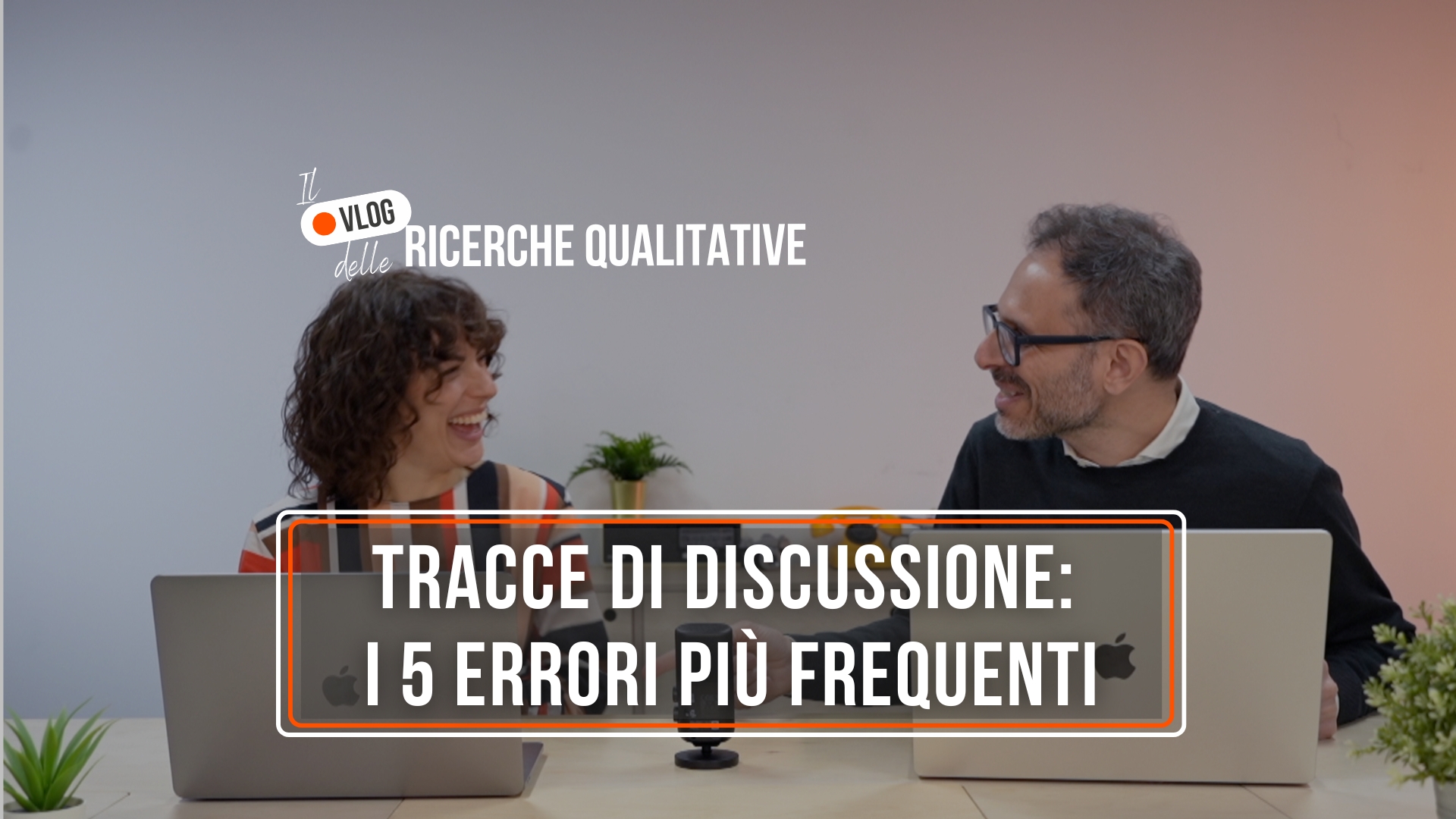
Watch the video below and learn about the 5 most common mistakes in discussion guides and how to avoid them! Improve the quality of your qualitative research with practical tips and effective strategies 🚀✨