Recollective is one of the first platforms created for managing qualitative online communities, and today it's among the most widely used (especially in the US and Canada), a market leader. It has multiple functions and tools that allow management of various types of projects, from the simplest and shortest to the most complex and long-term ones. It has considerable technological complexity, countless options, functions, and advanced features that aren't always necessary or known to researchers. Easy to use more in intention than in actual practice, as demonstrated by an advanced training program that the platform offers (for a fee).
In recent years, Recollective has given strong impetus to AI development, especially in results analysis logic. The platform's AI analysis is one of the best on the market, perfect for those who want an internal analysis tool that works through chat, with verbatim highlighting and advanced filtering – although it requires intermediate to advanced competence in managing AI tools.
Anyone who is a qualitative researcher is likely to have used Recollective for some online research project. We at Team Sicché, all qualitative research consultants with at least 15 years of experience in the sector, use it regularly – in fact, we started using it back in 2009, following its developments over the years.
Being a very sophisticated and advanced platform, it's our opinion that Recollective is the right choice for those who have already used this platform in the past (and are therefore comfortable with the logic it proposes), or for complex multi-country or long-term studies, preferably with a high number of participants.
Learning to manage the setup autonomously – that is, setting up variables and any recruitment filtering, setting up the discussion guide and related options for multiple countries or multiple weeks/months – is not easy: it requires time, training, and support.
Less suitable, in our opinion, for medium to short-term projects in few (or just one) countries, where the effort to learn the management logic (not always linear) doesn't correspond to the quick timelines or limited budget. Particularly if you have moderators, recruiters, colleagues who need to use the platform, for whom adequate training must therefore be provided.
Based on our experience, although it's a market leader, Recollective today has some limitations, especially for those seeking a purely qualitative, flexible, easy-to-use solution.
Paradoxically, having numerous functions and cutting-edge technology is also a weakness, because these advanced functionalities aren't always used (or discovered!), but risk being a deterrent to ease of use.
Let's look in detail at the main limitations of Recollective...
Recollective has always integrated standard question types, without considering the perspective of a qualitative researcher. The question types seem to arise more from technical and technological aspects and opportunities than from researcher experience. Open-ended responses, "fill the blanks", video responses, or closed response options have always been standards, nothing more.
Recollective only integrated voice message responses from mid-2023. Even today, to answer some question types, respondents must access from desktop/laptop, because it's not possible from mobile.
Unlike Recollective, Sicché doesn't just integrate "standard" questions but includes some options that come from the experience of qualitative researchers, the team of consultants who actually use various platforms and tools for online research, for decades.

Thanks to this experience, Sicché is the first qualitative platform to have inserted voice questions, as early as the beginning of 2020. But it's also the only qualitative platform in the world to integrate semantic differentials, in addition to scales, already including a set of over 50 pairs of opposites, ready to use, in different languages (but it's also possible to choose your own pairs of opposites).
Sicché is the first and only platform in the world to integrate associative tests, namely psychological projectives that allow respondents to answer in a less rational and less thought-out way, but more instinctive, more emotional, more authentic. The platform currently includes eight projective tests, such as the sea test, paintings test, animals test, houses test... Each test has its own area/field of use, as explained in the platform, but you're free to upload your own projective tools.
Needless to say, Sicché was conceived and designed to be usable by respondents from smartphones, 100% mobile, for any type of question. Even for viewing video or image stimuli, where pins need to be inserted or key moments that most impressed during viewing need to be selected.
Many market research institutes have the habit of inviting participants to a community, online diary, or pre-task the day before the start date, with the purpose of having respondents log in to resolve any technical issues and be ready to start the next morning.
On Recollective, this is technically possible (the participant receives the invitation message), but when they connect to log in the day before, they receive a technical error message, which is generic and doesn't explain the reason for the error. But as qualitative researchers, we know why this happens: the rental was paid to start from the following day, so the malfunction is technically correct, but... it provides participants with a very poor user experience (in some cases, throwing them into panic, with the result that some call recruiters, asking for confirmation of the research project and their participation).
On Sicché, participants can be invited without any problem and log in regularly. Once logged in, an automatic message welcomes them to the project, informing them that the research will begin the next day, at the time decided by the researcher (that is, the time corresponding to the start time of the first activity of the first day).
Support is fundamental both for researchers and participants on any platform. Support for respondents is crucial for the success of market research.
On Recollective, this support is provided, but not directly. In practice, communication is only possible between the respondent (who has the problem/need) and the researcher, who in turn has contact with Recollective's technical support. The renter (generally, the research institute) must therefore also cover the role of technical support, thanks to Recollective customer care support. In practice, they're the intermediary through which the respondent receives feedback about their problem. In English.
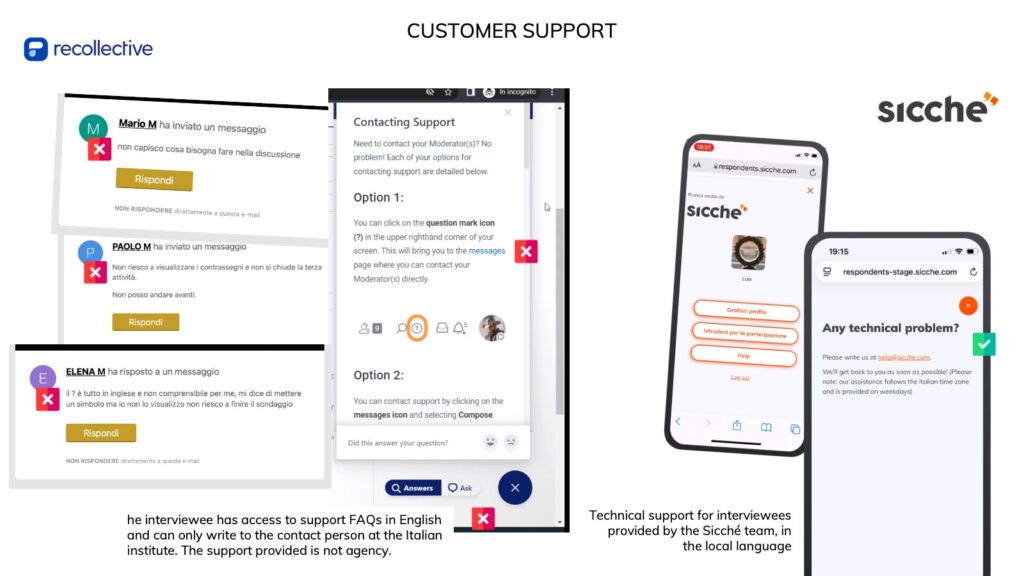
On Sicché, communication is direct, between the respondent and the Sicché team. This is because we know well from our experience that taking care of technical support also takes time, and researchers should only focus on moderating and analyzing results. Each respondent finds an email address to contact (from the Sicché team) directly within the platform's reserved area, in addition to receiving it in the body text of the first invitation email. The Sicché team – that is, we research consultants – respond according to Italian time zone, within a few hours, in the local language, thanks to AI.
In line with all other online platforms for qualitative research, regarding rental costs, Recollective calculates days consecutively, without exceptions, for on-demand rentals. This means that if a 4-day community starts on Thursday and doesn't include the weekend, technically the rental is paid for 6 days, from Thursday at 00:01 to 23:59 the following Tuesday. If then (as often happens) some respondents are late in providing their answers and it's necessary to extend the community duration by one day, an extra cost is expected to have all of Wednesday available, closing at 23:59. This applies with Recollective, but actually with all platforms, such as Incling, Kernwert, Liveminds, Qualzy, Krealinks...
Sicché's logic is profoundly, deliberately different. Because we know well that market research needs time to be well done, but also flexibility. For this reason, with Sicché's short-term research and diaries/pre-tasks, you only pay for the days we call "active," meaning those in which new questions, new activities are scheduled. Returning to the previous example, the 4-day community (from Thursday to the following Tuesday) would have had a lower cost, precisely because Saturday and Sunday wouldn't be active days, meaning they would be "empty" days (respondents could still complete their answers, but without finding anything new... they would in fact find the same activities and questions posted on Friday). And if respondents should be late with their answers? No problem, because with Sicché there are always 30 extra (non-active) days available for any late respondents... at no extra cost.
This means not only concrete savings in platform rental, but also a different, freer and more flexible way to propose and sell research, as explained here.
Almost all platforms created for qualitative research provide the possibility to set up individual moments (where respondents only dialogue with the moderator) or group moments (where participants can read other participants' content, comment on it, add likes, somewhat like on social networks).
Like many other platforms, Recollective follows activity-based logic, meaning the discussion is organized by "chapters," by "macro-themes," each of which is an activity, a container within which one or more questions are included. Each activity can be marked and set as "individual" or "group." However, Recollective's "group" activities have a strong structural limitation for those involved in qualitative research. Namely, each participant can browse through others' responses (thus adding comments, likes, etc.) only at the end of the activity, that is, only AFTER completing all the activity's responses. However, this makes spontaneous interaction among participants decidedly less likely, as well as less spontaneous. Because it's clear that each respondent has the desire and curiosity to compare IMMEDIATELY after providing their own answer, not at the end of 10 or 20 provided responses, when they may not even remember what they said and to which question...
On Sicché, however, at the end of each question (obviously, only in "group" activities), participants can browse through responses provided by other respondents, adding comments, likes, multimedia files. This aspect makes spontaneous comments easier, more spontaneous, more frequent; consequently, the level of engagement and interaction among participants is greater.
More generally, a fundamental theme that's increasingly relevant today is the ease of use of a platform, both for respondents and researchers. Because we want participants to have no problems, experiencing a fluid experience, free of hitches, for the sake of the data and insights we obtain. But at the same time, it's important that researchers are able to moderate, analyze data, and perform fundamental operations without any training, or just with a few tips.
With Recollective, the impression of many (not just ours) is that this isn't the case. Respondents often write to support, which they only find in English, which as seen is delegated to the researcher, not to the platform team's support. Labels are often not clear, immediate. Researchers need long training sessions; many functions seem designed more by engineers than by those who do our work 😅
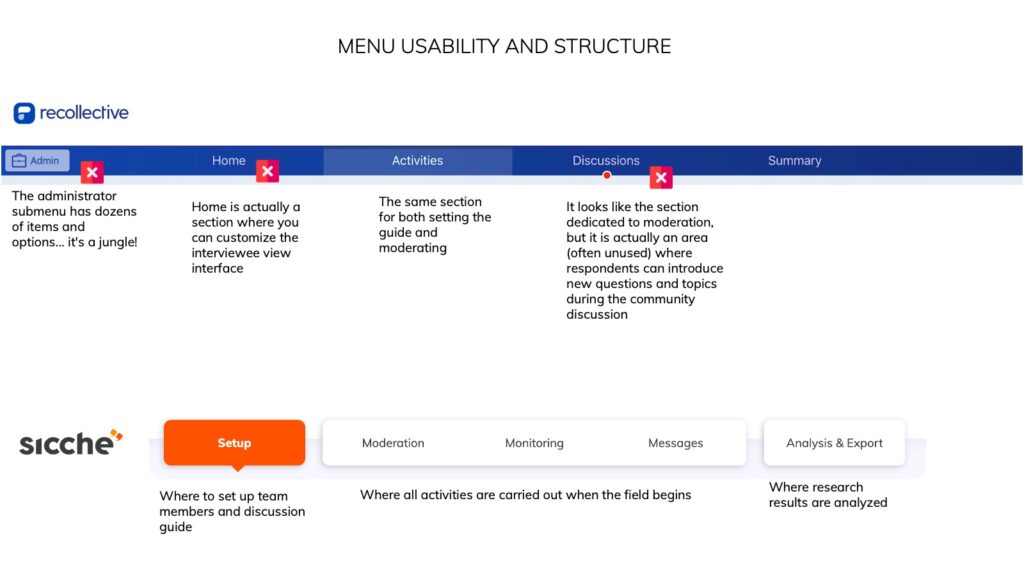
Sicché was born from our experience as researchers in UX, UI studies, interaction with digital platforms, websites, apps, prototypes. We always think about how to make users' lives easier. Advanced functions, often less used, are hidden, need to be sought out, don't represent useless "noise" along with those that are regularly used. Entering participants' variables on Sicché is a matter of a few minutes, following an intuitive flow that follows the logic of Excel sheets used by those involved in recruitment. On Recollective, this isn't easy; you need to understand the logic with which this procedure was created, adapt to its complication.
The word cloud function has been available on all platforms for some time now, thanks to its immediacy: a visual, impactful graphic.
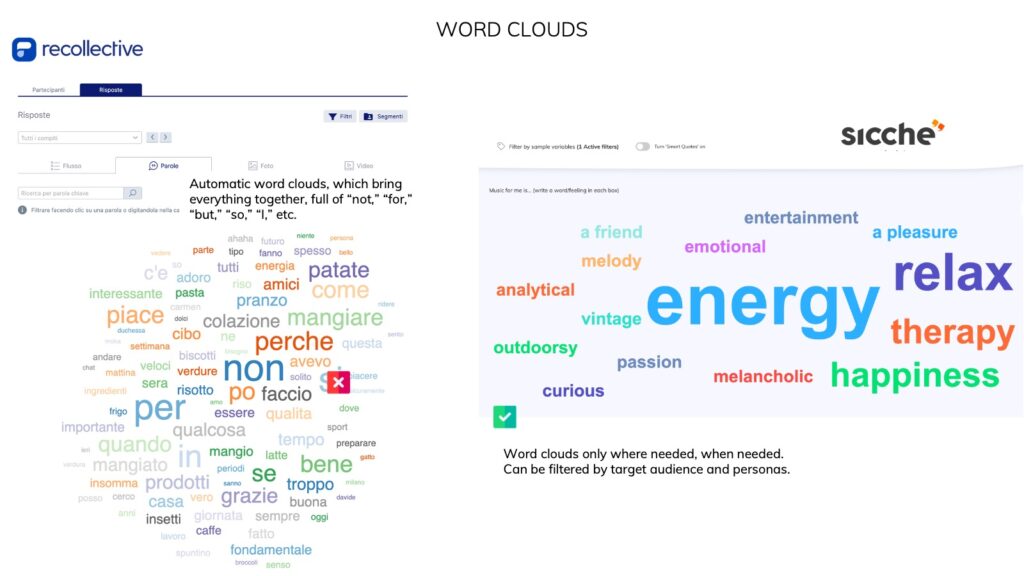
Recollective offers it as an always-available option: the automatic graphs that are created are full of useless words, and subsequent work is needed to make sense of this chaos. But shouldn't such a graph be immediate, easy to use, capable perhaps of showing, at a glance, the difference between two clusters or targets?
With Sicché, the word cloud is conceived as a question type in itself. Thanks to our experience as qualitative moderators, we've inserted "sentence completion" that is, that type of question widely used in qualitative research, where the first words or very brief phrases, instinctive, emotional associations are requested. The graph linked to this question is obviously a word cloud. But since we've asked the question in the right way, forcing participants to say the first words they had in mind, the word cloud will work very well, immediately, without needing to remove any words or "clean it up." And it will be possible to filter by sub-target and see how the graph changes in real time.
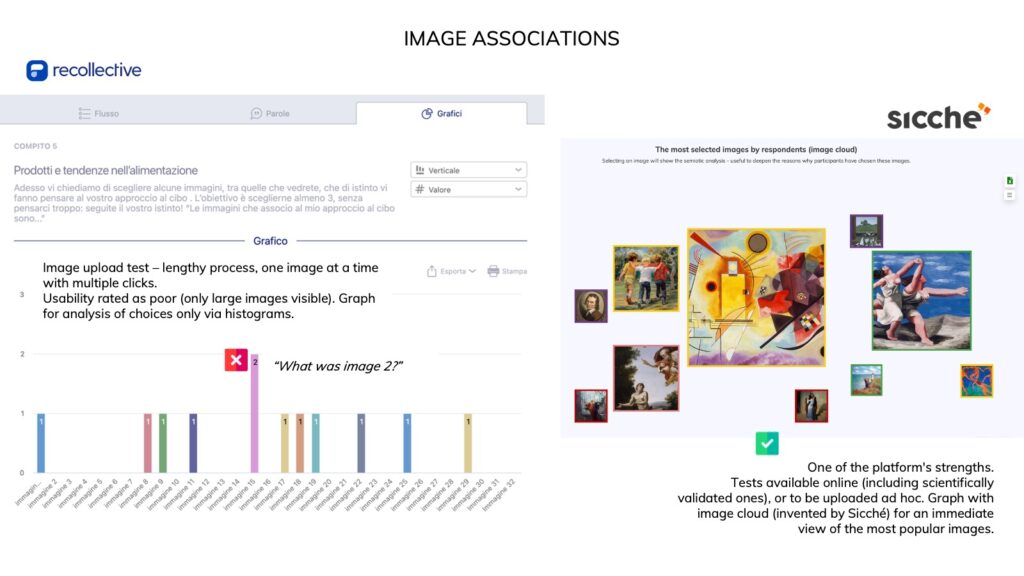
But there's more: our desire for a visual, direct, easy-to-use platform has driven us toward innovation of the "image cloud", a type of graph that only Sicché has. All competitor platforms, in any image tests, force the researcher to insert "little numbers" next to each image, then report a banal histogram as a graph, where various bars correspond to a little number (it's then up to the researcher to check which number corresponds to which image...)
On Sicché, this is decidedly easier and more direct: with the image cloud, the larger the images, the more they were chosen. Clicking on each image filters, thus allowing you to read only comments on that specific image. Easy, right? 😀
Data from online market research is generally archived at the end of a project through Excel files, text files, or other types. But being able to access the platform again after months or years to analyze results as was done during project execution is often an important need for a company or market research institute.
With Recollective, the research project is automatically closed after 30 days from the last field day. It's possible to extend this time period by an additional 14 days, for a fee. In any case, an automatic email will warn, with 48 hours' notice, that the research space will be closed, without being accessible anymore (thus inviting you to back up the data, downloading an Excel and all any multimedia content).
With Sicché, the research space remains open by default for 90 days following the 30 extra days (thus for 120 total days). Subsequently, the research can always be reopened in its original status (even after years), with a minimal activation fee. Naturally, data backup is always available.
Recollective’s pricing is based on U.S. rates, with generally strict terms set by them that are not flexible. The costs for on-demand rentals take into account the number of days (including inactive days; the total, with the platform closing to respondents at midnight on the last day) and the number of participants, with costs becoming significant starting at 7 days and 10 respondents (the minimum requirement, as shown in their online price list, which you can find on this page, scrolling down a bit, in the middle)... Prices start at $1,030.
Sicché makes flexibility its strength, even in the quotation phase. The days you pay for are only the active ones, as seen, plus costs (for diaries, pre-task, homeworks, journals) start from just €350. And on annual packages, the convenience isn't even comparable. Moreover, Sicché also provides annual rental without any limit on research projects.
Want to know more?