Discover techniques, examples, and the unique innovations of our platform.
Asking questions seems simple, but it's not. It's a task that requires preparation, necessitates following precise rules and procedures (e.g., to avoid bias and conditioning), a true art that is refined through experience.
Those who work in market research have their own "arsenal," their own techniques, their own preferences - when it comes to types of questions, even just regarding how they are posed.
Whether dealing with more or less structured questionnaires, or qualitative interviews or focus groups, the questions that respondents answer are never random, but the result of study and specific intentions.
Behind every question there is a precise purpose, an intention, a need to know something (okay, this is obvious), but the way it is posed can determine one type of response rather than another. It's up to us researchers to decide whether an open question, for example, should be more or less generic, or specific. More or less long, or brief... whether it should include certain specific words, or avoid others.
It's no coincidence that those who work in qualitative research, and thus often draft discussion guides for interviews or focus groups, are often psychologists with specific training, having taken courses like "research methodology," "interview and questionnaire techniques," etc.
Whatever discussion guide has been designed for interviews or focus groups will have within it a list of questions, all fundamentally open and textual. The moderator has them as support, naturally doesn't read them verbatim, but poses them in their own words, having clear objectives in mind, being careful to use the right terms, or to readapt them depending on the relationship with respondents.
But what are, fundamentally, the types of questions that the qualitative researcher has at their disposal?
Classic open questions, as seen
Open questions of the "sentence completion" type, useful for understanding impact reactions, first reactions, the first words that come to the consumer's mind. For example: "If I say x, what comes to mind? Tell me the first words..." In focus groups, these are often questions that require a quick round-table discussion to hear everyone's first words.
Open questions of the "association" type, to probe more projective, symbolic aspects, the experience linked to a concept or brand. For example: "What animal do you associate with x?", "If x transformed into a kitchen tool, what would it be?", "If x were a planet, how would you imagine it? Let's get closer... what do you see?"
Closed questions - which often constitute a brief pause from the interview or focus group, and require brief individual completion, sometimes (sigh!) still on paper, on sheets...
From our experience (we are a team of consultants in the world of qualitative research), we have noticed how many well-known and widely used platforms today seem to have been designed more by engineers or IT technicians than by those who work in market research.
Not only for ease of use and usability issues (which is often really complicated!). But also for the types of questions that are part of the tool. Indeed, often such question types seem to have been created more based on the technical opportunities that the platform provides (e.g., upload a video file, upload an image file) than on the opportunities that a type of question can give to those working in research.
How else would you explain that only we at Sicché have introduced the semantic differential, or associative tests, and still today, in 2025, we are the only platform in the world to have included them among our question types? 🥳
When we thought about our ideal platform, among other things we asked ourselves: "what other types of questions do we need?"
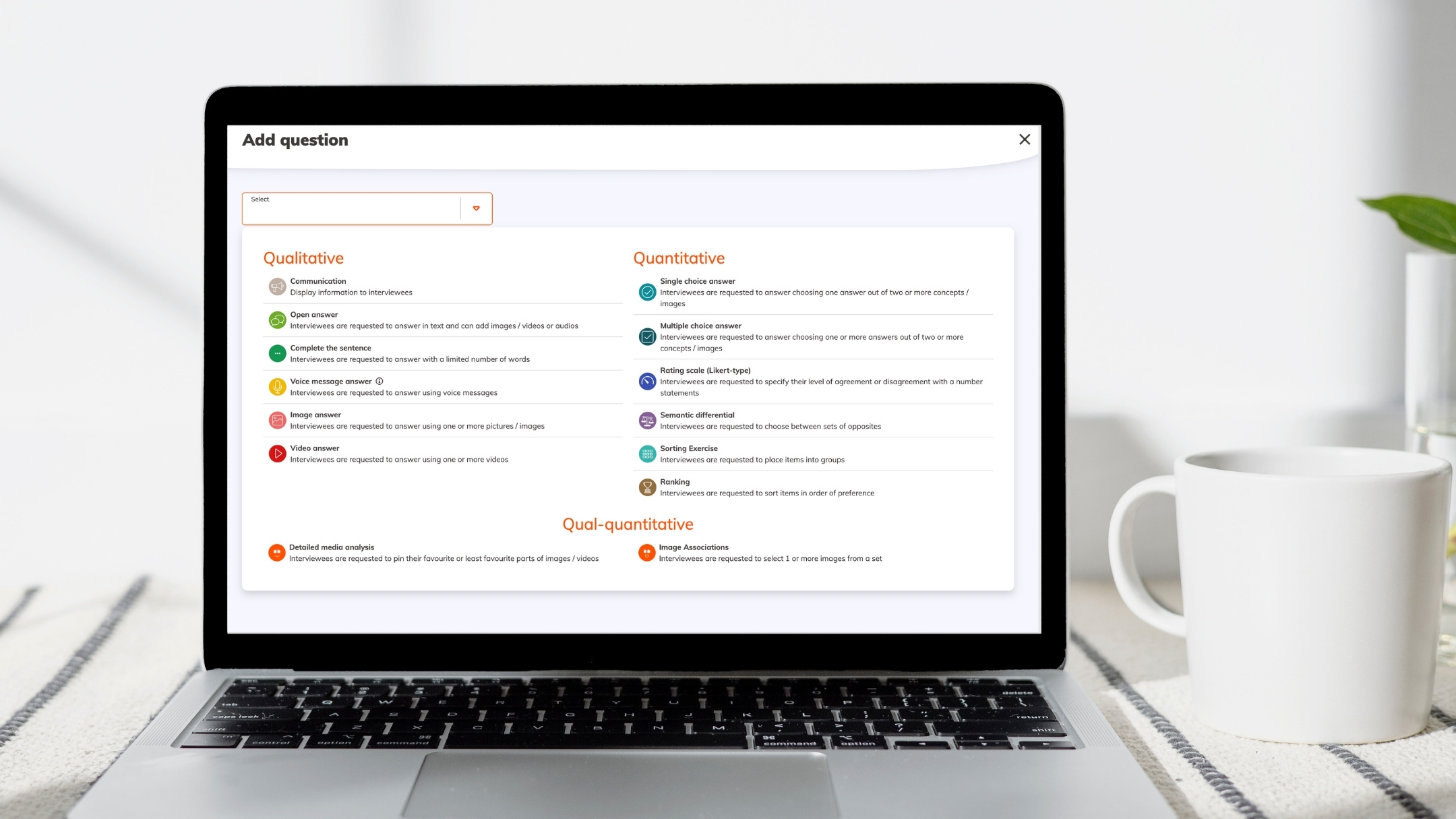
Everyone, on other platforms, stopped at the "classics" - namely open questions, closed questions (single and multiple choice), scales, some sentence completion (often called "fill the blanks"), which however wasn't quite what we had in mind, obviously responses via photos or videos.
But our work as qualitative researchers, our experience told us that it's not all there is.
That's why we went beyond. And we also included...
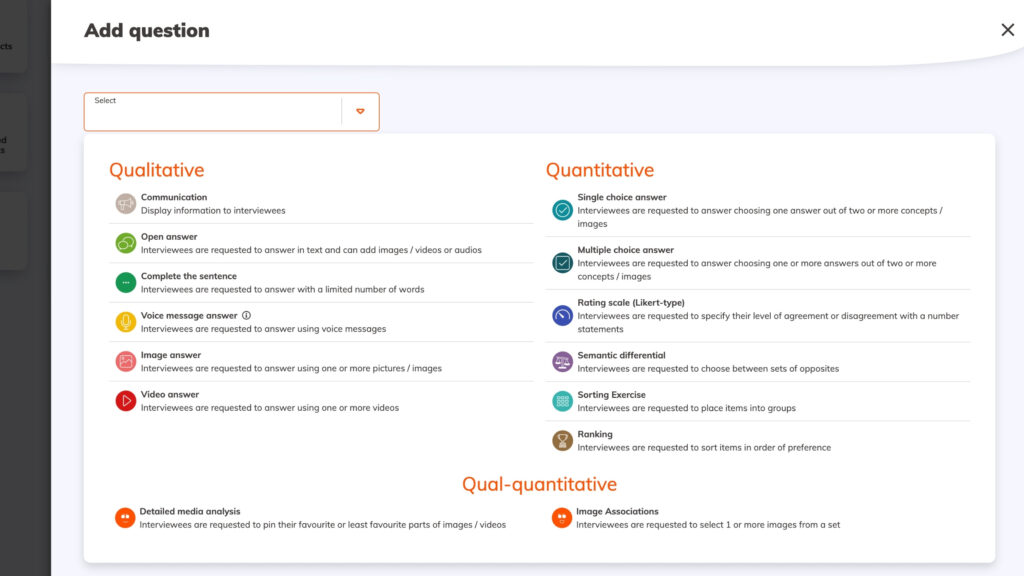
It seems incredible, but we were the first online qualitative research platform in the world to include questions via voice messages, as early as 2020. As Italians, we already noticed that our way of communicating had changed, for years now... and even more so during the pandemic.
Voice messages, audio messages have become the norm, often instead of a phone call - less young people might think of a "new era of answering machines" 😅
So why not make it possible to use this functionality also in a qualitative market research platform? We introduced it at the end of 2020, and it was immediately used.
Perfect for certain specific questions, when you need more of a first-person account, more authentic storytelling, with more details, without filters (speaking, you say more - according to some studies). Ideal for those questions from which we imagine getting those 2-3 impactful sentences, perhaps, for the results presentation (having them heard is more effective vs. a written verbatim).
As qualitative researchers, we have clearly in mind the value of symbolic associations. We have used techniques of all kinds, in focus groups and interviews, including cards and prints to have people choose from, or various types of tests, proprietary to some research institutes.
We said to ourselves: why not include tests already present in the platform? After all... the maximum creativity and associations, in general, was the open question with the request "take one or more images from Google that make you think of..." - with the result of having all didactic images, with low or no evocative and symbolic power.
And so, here are our tests - for details, we refer you here.
With sentence completion, we researchers ask for the first words, associations, adjectives that the person has in mind, once they've seen a concept, an image, a video, or faced with a brand, or any stimulus: we choose how many blank spaces need to be completed, and we're done.
The result we'll have, therefore, will be a word cloud, with the most frequently used words - filterable by target. Useful, right?
This is a really undervalued psychological tool. But widely used in psychology, in our experience as researchers we've seen it used few times.
But it's definitely effective when you need to understand in which "emotional direction" a certain product, concept, brand goes.
In the platform, you'll find 80 pairs of opposites already present, but obviously you can insert your own words!
Often open questions are inserted with a series of sub-points, details that you want the respondent to answer, but then it happens that they only respond to part of the requests.
With "sub-questions," it's like having automatic follow-ups: because each sub-point becomes an additional question, which the user MUST answer!
To add quantitative weight, or to make the discussion more varied, also with gamification in mind, these are useful options - often under-utilized.