In the world of digital qualitative research, tools that allow us to go beyond rational responses are increasingly strategic. When people discuss needs, experiences, or perceptions, they often filter what they say: some emotions remain implicit, others don't emerge at all, while still others get rationalized.
This is where associative tests and psychological reactives come into play: tools capable of bringing out deeper layers of experience, those connected to the symbolic, to memories, to immediate sensations.
Our direct experience as moderators of focus groups, individual interviews, and qualitative communities (all of us on the Sicché team are consultants) has taught us that when a participant can associate an image with a stimulus, a brand, or a personal experience, they access a more authentic, less controlled emotional language. Responses become more spontaneous, richer, unexpected.
This is why we have always believed in the value of projective tests as an integral part of market research that aims to generate deep, genuine, useful insights.
As we approach 2026, Sicché remains the only qualitative research platform in the world to integrate 8 different types of associative tests, available for any project and already included in the rental cost. A unique offering in the sector, which has been with us since 2019.
Each test is fully customizable: you can remove images from the original set or upload new ones, based on the market research needs. Or, upload your own sets of emotional reactives.
The result is not a common histogram (which in some platforms doesn't even show the corresponding image!), but an image cloud: a visual, immediate graphic where the most chosen images emerge powerfully, exactly as happens with textual word clouds. An intuitive format with great impact, perfect for reports and presentations.
Whether it's exploring emotions, brand experiences, latent needs, or perceptions along a journey, Sicché's digital psychological reactives offer a unique depth of analysis, without technical complications and without additional costs.
So, let's discover the tests currently available on the platform 😊

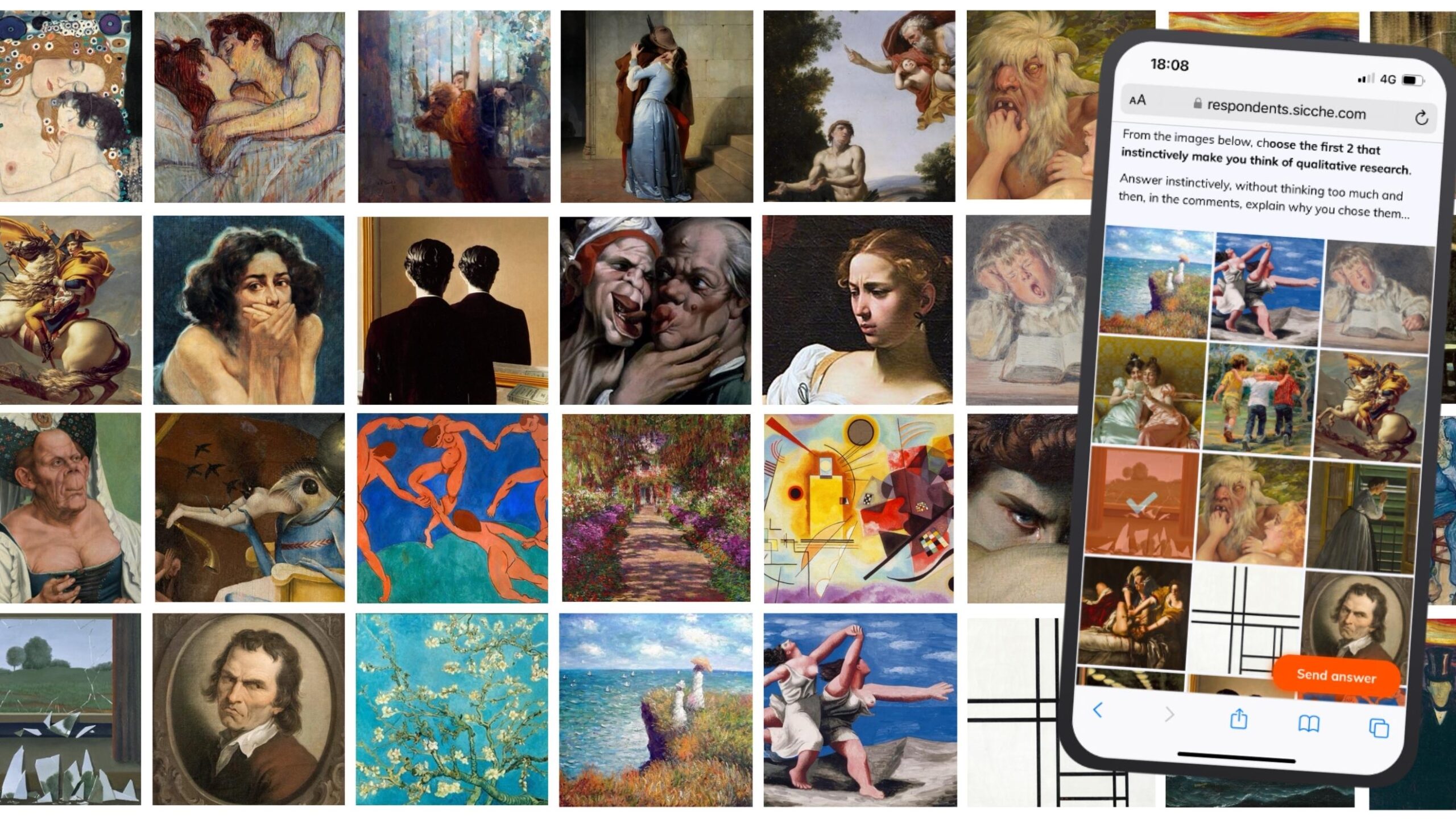
The Paintings Test is our most iconic emotional test. This associative tool was scientifically validated through a three-year collaboration with the University of Turin, rigorous work that guarantees its methodological reliability.
The reactive uses art as a universal emotional language: 40 carefully selected pictorial works, evenly distributed among different eras and artistic movements, figurative and abstract art, famous masterpieces and lesser-known paintings. Behind each image lies one of the 10 fundamental emotions (according to Izard's emotion theory model), mapped during the validation phase.
For the researcher, the test offers advanced analytical tools:
This projective tool is ideal for market research that needs to map the emotional territory connected to brands, concepts, experiences, or products. Given the validation in Italy, its use is recommended in our country, or in strongly related cultures.

The Sea Test exploits the evocative power of the water element to collect sensations, experiences, and emotions. The set includes 30 marine images carefully balanced: half positive and half negative, close-ups and panoramic shots, waters in motion and calm, color and black-and-white shots.
This psychological reactive proves particularly effective in recursive question flows, where the same stimulus is reproposed at different moments to monitor perceptual evolution. Think of customer journeys, patient journeys, or any experiential path where it's crucial to capture mood variations through different phases. The metaphor of the sea, universally understandable, allows tracking emotional transformations naturally and deeply.

Among the most flexible associative techniques on the platform, the Simple Abstract Images Test offers 52 evocative visuals with great impact and immediate comprehensibility. The images represent transversal emotions through shapes, colors, and compositions that speak a universal language.
The set is built to cover the entire experiential spectrum: positive and negative moods, individual and collective dimensions, static and dynamic contexts. The visual simplicity of this projective tool makes it suitable for multiple applications in qualitative research: from evaluating advertising concepts to brand positioning, from service analysis to understanding consumer expectations.

When the goal of qualitative research is to explore less obvious emotional territories, the Complex Abstract Images Test represents the ideal tool. With 90 deliberately articulated and multilayered visuals, this projective reactive pushes participants beyond stereotypical responses.
The set mixes heterogeneous elements: positive and negative emotions, realistic and dreamlike landscapes, graphic representations and photographs of concrete but often "extreme" objects or situations. The intentional complexity of the images stimulates less obvious and more revealing associations, bringing out nuances that simpler techniques might not capture.
The test was designed with the purpose of providing as many "hooks" as possible to the respondent, which can refer to shapes, colors, image details, conveyed sensations, or the "almost absurd" dimension of some options. Not an easy test, recommended for medium/high profile targets capable of arguing instinctive choices...

The Houses Test fits into the tradition of the deepest psychological reactives, using the universal symbolism of shelter and dwelling to reveal character traits and hidden needs. The 32 images of architectural structures span different styles, eras, and settings, offering multiple possibilities for identification and projection.
This associative tool excels when the goal of market research is to understand:
The house as a metaphor allows participants in qualitative surveys to express deep dimensions of their psychology without exposing themselves directly, making this test particularly effective even with targets less inclined to explicit introspection.

In an era when emoticons have become a universal everyday language, Sicché's eponymous test transforms this familiarity into a powerful qualitative analysis tool. The 40 selected emoticons cover a complete emotional spectrum: from primary emotions (joy, sadness, anger) to more articulated ones (frustration, confusion, surprise, embarrassment).
This projective reactive finds its ideal application in longitudinal monitoring of emotional states through multi-phase experiential paths. Think of patient journeys in the healthcare sector, onboarding paths for new digital services, product usage tests where each phase can generate different emotional reactions.
The immediate recognizability and absence of cultural barriers make emoticons accessible to any demographic target, transforming this associative test into one of the most democratic and versatile tools for contemporary market research.

The Colors Test is based on the principle that colors are not mere visual perceptions, but carriers of specific emotional and psychological meanings. The set includes 15 carefully selected shades: primary and secondary colors, plus the complete gray scale from white to black.
This psychological reactive is particularly effective in market studies related to:
It's important to emphasize that, while universal chromatic archetypes exist, color-emotion associations can vary between cultures and individual experiences. For this reason, in qualitative research involving multicultural targets, interpretation of results requires particular attention to context.

The Animals Test brings back to digital qualitative methodologies one of the most classic and proven reactives of the psychological tradition: the question "if it were an animal, what would it be?". Sicché's set includes 90 images of different species, chosen to represent differentiated characteristics, habitats, and behaviors. Pufferfish included 🤣
Each image is selected to evoke specific qualities: the strength of the lion, the cunning of the fox, the freedom of the eagle, the industriousness of the ant, the friendliness of the dolphin. This associative tool lends itself to multiple uses in market research:
The metaphorical richness of the animal world, combined with its universal comprehensibility, makes this projective test a valuable ally for exploring identity and value dimensions in qualitative analysis of every product sector.
Sicché's associative tests represent much more than simple additional features: they are the result of years of field experience, of the deep conviction that qualitative methodologies must go beyond direct questions to access that emotional and symbolic dimension where the most precious insights reside.
To maximize the value of associative tools in market studies, the platform provides by default, on the respondent side, the obligation to provide a mandatory comment regarding the choice made, transforming the visual choice into a moment of verbalized reflection that enormously enriches the interpretation of qualitative data.
With 8 validated, customizable, and always included projective reactives, Sicché offers market researchers the tools to transform every qualitative research into an opportunity for authentic discovery, where images speak louder than words and emotions emerge naturally.
Are you ready to use a test in your online market research?