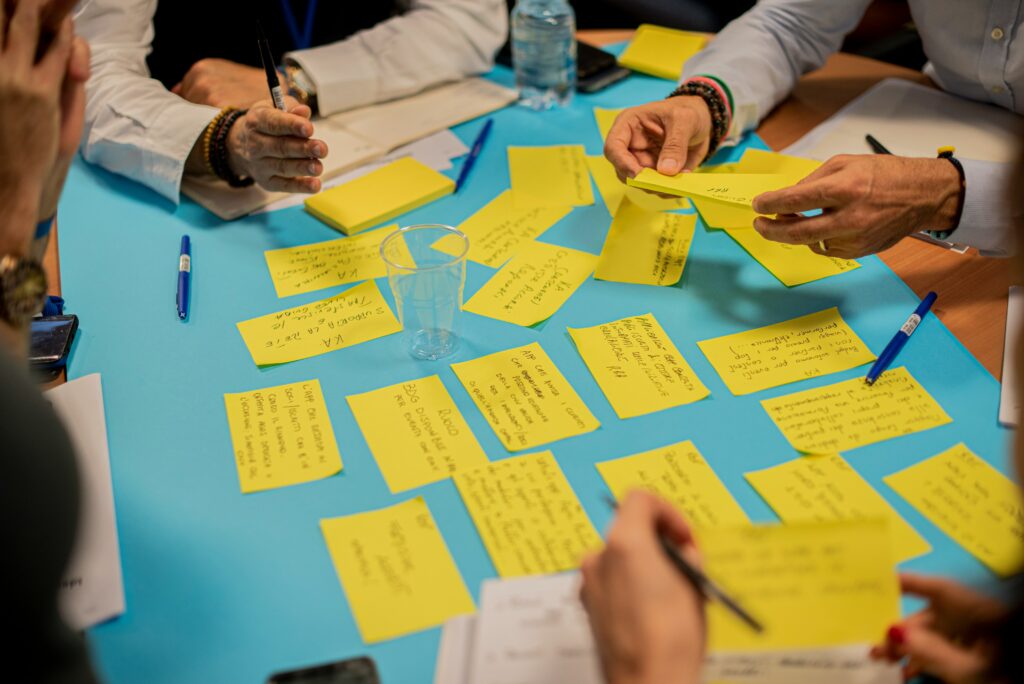
When we talk about qualitative research, it’s easy to picture people sitting in a circle, maybe with a cup of coffee in hand, chatting passionately about a product, an ad, or a shopping experience. And rightly so—focus groups, or discussion groups, have been the beating heart of market research tools for decades.
But in recent years, things have evolved. With the rise of digital, group conversations are no longer limited to a room with a one-way mirror. We now have online focus groups, insight communities, online discussion forums, digital diaries… In short, the range of options has expanded—along with the questions about what to use, when and why.
Let’s bring some clarity to the chaos (without putting anyone to sleep).
The focus group was born in the U.S. during World War II. Sociologist Robert Merton—yes, the same guy behind the anomie theory—was looking for a way to understand how soldiers reacted to propaganda. So he came up with a format where a small group of people discussed guided by a moderator, with the goal of uncovering the “why” behind certain opinions.
Since then, the method has been embraced in advertising, politics, social research, and of course, commerce. It became a timeless classic of qualitative research. What makes it so effective? The energy of live interaction, spontaneous group dynamics, emotional reactions that surface only when you’re looking people in the eye.
Of course, organizing an in-person focus group isn’t exactly a walk in the park: renting the venue, coordinating participants, providing snacks, dealing with logistics… it can get pricey and time-consuming. But it remains a powerful method to deeply explore people’s experiences—especially when it comes to tactile, sensory or visual elements.
With the rise of the internet, focus groups went digital too. Enter the online discussion groups: same structure as traditional focus groups, but participants join from home, via video call—or even just via chat.
This format boomed during the pandemic (though it was already gaining popularity), offering a flexible, more affordable solution that also happens to be accessible to geographically dispersed targets. All you need is a good connection and a device, and voilà—you can join from your sofa or your lunch break.
Sure, there are downsides: it lacks the magic of a face-to-face encounter, body language can be harder to read (and only if everyone’s on camera), and interactions can sometimes feel a bit flat. Still, it’s a very valid alternative, especially when time and budget are tight.

And then there’s the real game-changer: insight communities, also known as web discussions or community insight groups. A quiet revolution in the world of qualitative research.
We’re no longer talking about a one-off two-hour session, but rather a journey. An insight community platform is an online space where a group of users participates in structured activities over several days, weeks or even months. They write, share photos, keep digital diaries, comment in online discussion forums, reflect, revisit their thoughts. And everything happens via asynchronous communication—meaning people participate whenever they want, no set schedule.
This approach goes much deeper. Participants aren’t under pressure, they have time to think, and they open up more. The amount (and quality) of insight you can gather is truly impressive. It’s like upgrading from a quick chat at the bar to a long, meaningful conversation with a friend on holiday.
Sure, managing an online community takes effort: ongoing moderation, well-designed activities, and the right tech setup. But the results speak for themselves—especially when the goal is to observe behavior over time or test iterative content (like concepts, creative ideas or user experiences).

Ah, the million-dollar question. The most honest answer is: it depends.
If you need to capture emotional reactions to a physical product, fresh out of the R&D lab, nothing beats an in-person focus group. If you want to test a campaign in multiple cities at once—without moving a single truck—online focus groups are your friend. And if you're after authentic, contextualized insight into people's everyday lives, a good asynchronous community insight group is the way to go.
The key is not to get stuck in nostalgia or chase the latest trend. Today we have a real toolbox at our disposal, and it’s up to us to choose the right tool based on the research goals—and maybe even combine them. Modular approaches often deliver the richest insights: a focus group can be followed by a digital diary, or a web discussion can set the stage for a follow-up online focus session.
Discussion groups have evolved, but their core mission remains the same: to truly listen to people. Whether it’s in a room with a one-way mirror, on Zoom, or through a digital platform, what really matters is the quality of the conversation, the empathy of the moderator, and the sharpness with which we analyze what emerges.
We believe that insight communities are among the most complete solutions today for gathering deep, rich and authentic insights. That’s why we build tools specifically designed to support asynchronous interactions, online discussion forums, digital diary activities, and long-term research projects.
Curious to see how an online community really works? Let us show you. No glossy brochures—just a direct dive into the platform (and maybe, who knows, into your consumers’ minds).
Get in touch—we’d love to chat!
info@sicche.com